Let’s face it, today’s digital communication is saturated across nearly every industry.
In this context, industrial suppliers face a specific challenge: creating content that captures the attention of engineers and designers who value precision and reliability over catchy slogans.
For this audience, the value of content is not measured by creativity, but by how useful it is in their design and decision-making processes.
To help you create high-value resources for an industrial audience, let’s explore how to build a content strategy designed specifically for the engineering world.
A pragmatic audience that demands verifiable proof
Traditional marketing often recommends using storytelling to create emotional connections and engagement.
In the industrial world, that approach loses much of its impact: here, persuasion is driven by logic, not emotion.
Engineers are a technical audience that seeks reliable data, documented results, and tangible evidence.
Overly general or promotional content is quickly dismissed. Conversely, a case study describing an application context, the constraints encountered, and the results achieved becomes a valuable working tool.
This type of content builds trust by demonstrating the relevance of a solution rather than presenting it as a simple sales argument.
A long and shared decision-making cycle
In the industrial sector, decision-making is rarely linear. Multiple stakeholders are involved: engineers, technical managers, procurement teams, and executives. Each with their own evaluation criteria:
- Performance and reliability for engineers
- Total cost and ROI for managers
- Regulatory compliance for executives
A well-designed content strategy must therefore offer multiple perspectives.
The same topic can be presented as an in-depth technical article for designers, a performance-oriented summary for buyers, or a risk management overview for decision-makers. This segmented approach covers the full decision-making chain without diluting the core message.
The formats engineers prefer
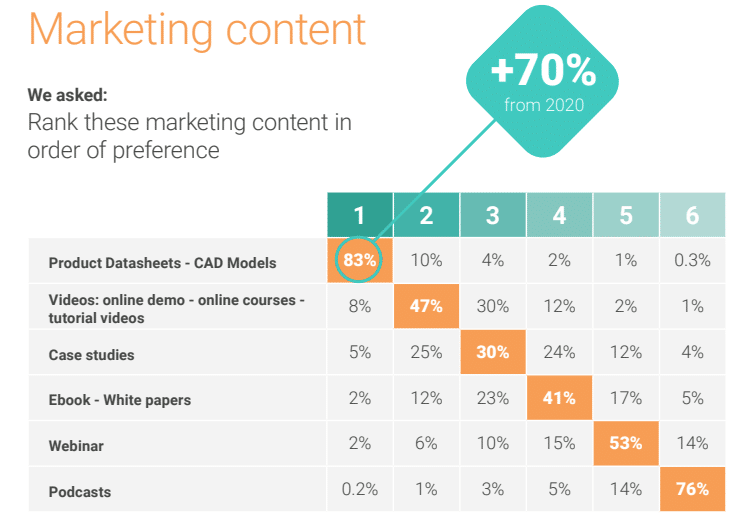
Engineering professionals prefer formats that allow them to analyze quickly and apply information directly.
- CAD Models that they can integrate into their design
- Case studies provide concrete and measurable examples.
- Technical videos and demonstrations simplify complex processes.
- Interactive tools (calculators, configurators, simulators) allow engineers to test a solution in their own context.
Reusing technical documentation is also a highly effective practice.
Transforming a product sheet into a practical guide or tutorial adds value to existing materials while making them more accessible.
Using these formats effectively is one of the key pillars of a successful industrial content strategy, as they align directly with how engineers approach their projects.
Trends redefining industrial content
Three major shifts are transforming how engineers consume and evaluate content today:
These trends demonstrate that a high-performing strategy relies not only on content creation but also on adaptability, to both technological evolution and audience expectations.
Moving toward a sustainable, industry-specific strategy
Building an effective content strategy in the industrial sector isn’t about producing more content, but about defining a progressive and measurable approach.
A good starting point is auditing your existing materials to identify priority needs.
The next step is selecting the most relevant formats to enhance each piece of content, followed by implementing a process for deploying, testing, and optimizing your strategy.
This approach requires time and rigor, both to process existing data and to create new content, but it establishes long-term credibility with an audience for whom trust is a decisive factor.
In this context, and with a content strategy tailored to the industry, content goes beyond information: it becomes a strategic lever for customer relationships and competitive differentiation.
How TraceParts helps component suppliers reach their audience
TraceParts occupies a unique position between component suppliers, CAx software vendors, 3D printing professionals, and their audience of engineers and design professionals. This gives us a deep understanding of how engineers and designers search for information, evaluate solutions, and interact with technical content.
This insight allows us to provide tailored recommendations aligned with how this audience analyzes data and makes decisions.
To complement these principles, our 2024 Industrial Marketing Engagement Report offers a data-driven foundation you can act on immediately. Based on responses from 1,476 platform users, the report identifies which formats and approaches truly capture engineers’ attention.
After these strategic insights, it gives you a solid foundation to structure a relevant, effective content strategy today.
Discover real-world data


 Deutsch
 Français
 Italiano
 Español
 Português
 中文 (中国)
 日本語
日本語 Русский






 24/07/2024
  Digital Advertising Solutions, Email Campaigns